Christianity
Q&A for committed Christians, experts in Christianity and those interested in learning more
Latest Questions
1
votes
0
answers
79
views
What are the official positions of the various denominations on LLMs?
LLMs (Large Language Models), the technology behind ChatGPT, BingChat, Gemini, Mistral AI, etc., is on the rise, and the current and future generations will use this technology as a primary technology. This prompts the question of what the official position of each denomination/church on the usage o...
LLMs (Large Language Models), the technology behind ChatGPT, BingChat, Gemini, Mistral AI, etc., is on the rise, and the current and future generations will use this technology as a primary technology.
This prompts the question of what the official position of each denomination/church on the usage of LLM is.
(Note: I am looking for the official position of each church and denomination, not personal opinion.)
telion
(737 rep)
Jun 5, 2024, 08:52 PM
• Last activity: Jun 6, 2024, 01:56 AM
1
votes
2
answers
541
views
What is the wording used for Christadelphian baptism?
The top answer currently on the question [Would a person baptized by a Biblical Unitarian church be considered a Christian by the Catholic Church?][1] links to a document [Valid baptisms reference list][2] from the Catholic diocese of Columbus which lists which denominational baptisms the diocese co...
The top answer currently on the question Would a person baptized by a Biblical Unitarian church be considered a Christian by the Catholic Church? links to a document Valid baptisms reference list from the Catholic diocese of Columbus which lists which denominational baptisms the diocese considers to be valid.
One that is considered invalid is the Christadelphian baptism. Part of the requirement for a valid baptism by the Catholic Church is the phrase
> "I baptize you in the name of the Father, and of the Son, and of the
> Holy Spirit"
which is very similar to Matthew 28:19's
> "Therefore, go and make disciples of all the nations, baptizing them
> in the name of the Father and the Son and the Holy Spirit"
What is the wording Christadelphians use when baptizing?
Only True God
(7012 rep)
May 17, 2022, 05:57 PM
• Last activity: Jun 5, 2024, 10:18 PM
6
votes
1
answers
693
views
If Satan is not a person, how do Christadelphians explain what "satan" was in the case of Job?
This is related to [this other question][1] about the Christadelphian view that Satan is not a person. Here I wanted to ask how they view the case of Job. Job was apparently a real person as he is referred to in Ezekiel 14:14 where God said the words > Though these three men, Noah, Daniel, and Job,...
This is related to this other question about the Christadelphian view that Satan is not a person.
Here I wanted to ask how they view the case of Job. Job was apparently a real person as he is referred to in Ezekiel 14:14 where God said the words
> Though these three men, Noah, Daniel, and Job, were in it, they should
> deliver but their own souls by their righteousness, saith the Lord
> GOD.
Also James 1:13 says that God cannot be tempted with evil and does not bring about tests upon us just to see if we fail them or not
> Let no man say when he is tempted, I am tempted of God: for God cannot
> be tempted with evil, neither tempteth he any man:
In the case of Job the Bible gives this conversation between Satan and God (Job 2:2-3)
> And the LORD said unto Satan, From whence comest thou? And Satan
> answered the LORD, and said, From going to and fro in the earth, and
> from walking up and down in it. And the LORD said unto Satan, Hast
> thou considered my servant Job, that there is none like him in the
> earth, a perfect and an upright man, one that feareth God, and
> escheweth evil? and still he holdeth fast his integrity, although thou
> movedst me against him, to destroy him without cause.
In the context of Job, do Christadelphians view Satan as a principle of evil within God, some separate entity, or something else?
neo
(338 rep)
Jul 8, 2022, 05:11 PM
• Last activity: Jun 5, 2024, 10:13 PM
2
votes
3
answers
2954
views
Do Christadelphians celebrate Christmas?
I noticed from other questions that Christadelphians do not accept some doctrines shared by mainstream Christian religions, for example that of hellfire or that Jesus is part of a Trinity and is equal to God. They seem to share a view with some other faiths that Christianity was corrupted some time...
I noticed from other questions that Christadelphians do not accept some doctrines shared by mainstream Christian religions, for example that of hellfire or that Jesus is part of a Trinity and is equal to God. They seem to share a view with some other faiths that Christianity was corrupted some time after the 1st century.
Based on this I wanted to ask about Christian celebrations that seem to have a pagan origin, such as Christmas. Do Christadelphians celebrate Christmas?
alec
(636 rep)
Feb 15, 2023, 03:24 PM
• Last activity: Jun 5, 2024, 10:10 PM
1
votes
3
answers
259
views
How do penance or punishment, as opposed to repentance or destruction, make the universe a better place?
A recent question, [How do believers in hell respond to the argument "What finite crime deserves an infinite punishment?"?](https://christianity.stackexchange.com/questions/101213/how-do-believers-in-hell-respond-to-the-argument-what-finite-crime-deserves-an) leads to a more fundamental question: **...
A recent question, [How do believers in hell respond to the argument "What finite crime deserves an infinite punishment?"?](https://christianity.stackexchange.com/questions/101213/how-do-believers-in-hell-respond-to-the-argument-what-finite-crime-deserves-an) leads to a more fundamental question:
**How do penance or punishment, as opposed to repentance or destruction, make the universe a better place?**.
We know that God has a purpose for everything he does:
> **Exodus 9:18** But indeed for this purpose I have raised you up, that I may show My power in you, and that My name may be declared in all the earth.
>
> **Job 42:2** “I know that You can do everything, And that no purpose of Yours can be withheld from You.
>
> **Ecclesiastes 3:1** To everything there is a season, A time for every purpose under heaven:
>
> **Ecclesiastes 3:17** I said in my heart, “God shall judge the righteous and the wicked, For there is a time there for every purpose and for every work.”
>
> **Isaiah 14:24** The LORD of hosts has sworn, saying, “Surely, as I have thought, so it shall come to pass, And as I have purposed, so it shall stand:
>
> **Isaiah 14:27** For the LORD of hosts has purposed, And who will annul it? His hand is stretched out, And who will turn it back?”
>
> **John 12:27** “Now My soul is troubled, and what shall I say? ‘Father, save Me from this hour'? But for this purpose I came to this hour.
>
> **Romans 8:28** And we know that all things work together for good to those who love God, to those who are the called according to His purpose.
>
> **Galatians 3:19** What purpose then does the law serve? …
>
> **Ephesians 1:11** In Him also we have obtained an inheritance, being predestined according to the purpose of Him who works all things according to the counsel of His will,
>
> **Revelation 17:17** “For God has put it into their hearts to fulfill His purpose, …
We know that God is a god of love and forgiveness:
> **Zephaniah 3:17** The LORD your God in your midst, The Mighty One, will save; He will rejoice over you with gladness, He will quiet you with His love, He will rejoice over you with singing.”
>
> **John 3:16** “For God so loved the world that He gave His only begotten Son, that whoever believes in Him should not perish but have everlasting life.
>
> **Acts 5:31** “Him God has exalted to His right hand to be Prince and Savior, to give repentance to Israel and forgiveness of sins.
>
> **Romans 5:8** But God demonstrates His own love toward us, in that while we were still sinners, Christ died for us.
>
> **Ephesians 2:4** But God, who is rich in mercy, because of His great love with which He loved us,
>
> **Colossians 2:13** And you, being dead in your trespasses and the uncircumcision of your flesh, He has made alive together with Him, having forgiven you all trespasses,
>
> **1 John 4:8** He who does not love does not know God, for God is love.
>
> **1 John 4:10** In this is love, not that we loved God, but that He loved us and sent His Son to be the propitiation for our sins.
The simple view presented in the Bible is that eventually all mankind will either:
- Repent, accept God's way of life, and receive eternal life (the vast majority).
- Reject God and be permanently destroyed (a small number of incorrigible).
> **1 Timothy 2:3–4**
For this is good and acceptable in the sight of God our Savior,
who desires all men to be saved and to come to the knowledge of the truth.
>
> **Revelation 20:15** And anyone not found written in the Book of Life was cast into the lake of fire.
But many denominations believe that:
- After repentance, one still needs to do penance (and Catholics believe in additional purgatory after death).
- If one does not accept God, one will have an eternal life of perpetually experiencing punishment, with no hope of its ever ending.
The words "penalty" and "retribution" do not appear in the Bible (KJV).
In the New Testament, "vengeance" appears only once, and "justice" not at all.
But "love" appears over 500 times in the Bible.
And "forgive" appears more than 50 times in each of the Old and New Testaments.
Given that God's message is one of love and forgiveness, not of vengeance and punishment, what do those that believe in punishment say is **God's purpose** in choosing to make people suffer after death (i.e. what good will result from it)?
### Note:
**I'm not asking why God punishes sinners.
I'm not asking why God permanently destroys incorrigible unrepentant sinners.
I'm asking why, rather than extermination, some denominations teach that God will perpetually torture these sinners; what purpose do these denominations think this will serve?**
Ray Butterworth
(13759 rep)
May 2, 2024, 04:22 PM
• Last activity: Jun 5, 2024, 07:06 PM
3
votes
1
answers
560
views
What is the theological difference between anthropomorphism and theanthropism?
I understand from [this article](https://www.gotquestions.org/anthropomorphism.html) that anthropomorphism is the process of assigning human characteristics to God: >Anthropic means “relating to human beings or their existence.” The word anthropomorphism comes from two Greek words, anthropos, meanin...
I understand from [this article](https://www.gotquestions.org/anthropomorphism.html)
that anthropomorphism is the process of assigning human characteristics to God:
>Anthropic means “relating to human beings or their existence.” The word anthropomorphism comes from two Greek words, anthropos, meaning “man,” and morphe, meaning “form.” In theological terms, anthropomorphism is the process of assigning human characteristics to God. Human traits and actions are ascribed to the Creator. We read of God’s actions, emotions, and appearance in human terms, or at least in words we normally accept and associate with humans.
Then I came across the word theanthropism. My 1979 Collins English Dictionary said:
>Theanthropism – ascription of human traits or characteristics to God. ‘Theol’ – doctrine of hypostatic union of divine and human natures in the person of Christ.
How is theanthropism theologically different from anthropomorphism? Does it relate to the union of the divine and human natures in Christ?
Lesley
(34959 rep)
Jun 5, 2024, 12:10 PM
• Last activity: Jun 5, 2024, 03:39 PM
2
votes
2
answers
134
views
What is the earliest source containing the 'Stabat Mater' melody from the 1961 Liber Usualis?
I would like to find the earliest source containing the [*Stabat Mater*][1] melody on [page 1634V from *The Liber Usualis*][2], Solesmes, 1961 edition: [ ][1] If the earliest source is not known, I would like a source before 1961. I checked the 1896 *Liber Usualis* (pg 1229) and the 1924 *Liber Usua...
I would like to find the earliest source containing the *Stabat Mater* melody on page 1634V from *The Liber Usualis* , Solesmes, 1961 edition:
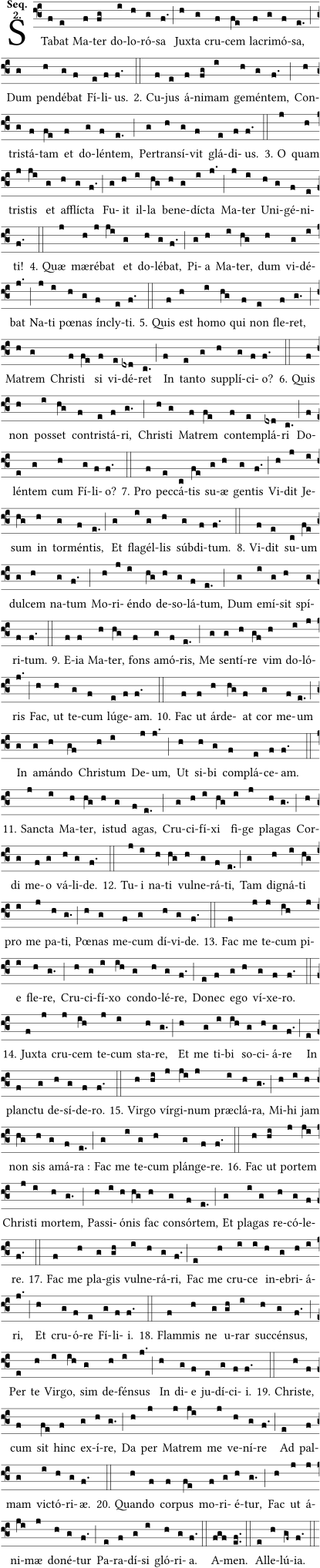 If the earliest source is not known, I would like a source before 1961.
I checked the 1896 *Liber Usualis* (pg 1229) and the 1924 *Liber Usualis* (pg 1644), but both have a different melody.
If the earliest source is not known, I would like a source before 1961.
I checked the 1896 *Liber Usualis* (pg 1229) and the 1924 *Liber Usualis* (pg 1644), but both have a different melody.
R. B. Jawad
(55 rep)
Jan 2, 2023, 01:22 AM
• Last activity: Jun 5, 2024, 02:02 AM
5
votes
2
answers
642
views
Does Acts 13:15 imply the synagogues were very social and allowed strangers to speak to the congregation?
I never noticed before but I have wondered how the Apostles were always freely given the opportunity to preach in the synagogues? In our modern day churches (aside from some charismatics) allowing someone not well known to speak to the congregation is almost unheard of. The verse that came to my att...
I never noticed before but I have wondered how the Apostles were always freely given the opportunity to preach in the synagogues? In our modern day churches (aside from some charismatics) allowing someone not well known to speak to the congregation is almost unheard of.
The verse that came to my attention is Acts 13:15
Acts 13:15 ESV
> After the reading from the Law and the Prophets, the rulers of
> the synagogue sent a message to them, saying, “Brothers, if you have
> any word of encouragement for the people, say it.”
Does this mean strangers who visited other churches (who appeared normal I guess?) were commonly given a warm hand of fellowship and offered to share?
Are there any other scriptures indicating an affirmative or negative to this idea?
Not sure if this relates to the free ability to publicly raise questions? For example, Jesus at the temple as a child. I can’t imagine how a child (not allowed to speak of course) could yet be able to debate or ask questions with the pastor of a modern church? Not sure what it is but something seems different.
Mike
(34698 rep)
Jun 1, 2024, 01:01 PM
• Last activity: Jun 4, 2024, 09:17 PM
7
votes
4
answers
1513
views
What is the cause of the re-emergence of premillennialism?
Revelation 20:1-10 speaks of Christ reigning for a thousand years, which is taken as a literal kingdom of Jesus on earth after his second coming by premillennialists. Amillennialists, on the other hand, understand the thousand-year-reign of Christ to refer to the era of the church, which will conclu...
Revelation 20:1-10 speaks of Christ reigning for a thousand years, which is taken as a literal kingdom of Jesus on earth after his second coming by premillennialists. Amillennialists, on the other hand, understand the thousand-year-reign of Christ to refer to the era of the church, which will conclude with the second coming and final judgment.
This debate is ancient. Justin Martyr's *Dialogue with Trypho* (composed around 160 AD) is the earliest extant work to explicitly weigh in on the issue. Justin takes a premillennialist view, prefacing the discussion with a disclaimer that faithful Christians are not in agreement on it (ch.81). Irenaeus also advocated premillennialism. Eusebius, himself amillennialist, gives an interesting report of a debate on the issue in Alexandria taking place in around 250 AD (*Ecclesial History* 7.24-25). In *City of God* (dating to the early 5th century), Augustine reports his own switch from premillennialism to amillennialism, with a brief but compelling argument for why this is correct (Book XX).
As I understand it, amillennialism was far-and-away the dominant view from the time of Augustine until the Reformation. Calvin dismisses premillennialism as "too childish either to need or to be worth a refutation," (*Institutes* Book 3, XXV.5), but he seems to misunderstand it as postulating that the resurrected saints will only live for that thousand years.
In the present time, the situation seems to have changed. Premillennialism is an integral part of Dispensationalism, which remains quite popular in American churches. But even outside Dispensationalism, one finds many premillennialist theologians, such as John Piper or Wayne Grudem or [reportedly] Charles Spurgeon.
My question is: **Among non-Dispensationalist theologians, why has premillennialism returned?** Does the resurgence of historical premillannialism have anything to do with the advent of dispensational premillennialism?
user62524
May 27, 2024, 09:19 AM
• Last activity: Jun 4, 2024, 08:32 PM
3
votes
4
answers
2248
views
According to Christian proponents of Intelligent Design, is Satan blinding the minds of the advocates of naturalistic abiogenesis and evolution?
Proponents of intelligent design in both the universe and biology highlight several noteworthy features of nature. These include the [fine-tuning of the universe](https://en.wikipedia.org/wiki/Fine-tuned_universe), the [surprising applicability of mathematics to the cosmos](https://philosophy.stacke...
Proponents of intelligent design in both the universe and biology highlight several noteworthy features of nature. These include the [fine-tuning of the universe](https://en.wikipedia.org/wiki/Fine-tuned_universe) , the [surprising applicability of mathematics to the cosmos](https://philosophy.stackexchange.com/q/111145/66156) , the extraordinary complexity of even the simplest cells, and concepts such as [irreducible complexity](https://en.wikipedia.org/wiki/Irreducible_complexity) and [specified complexity](https://en.wikipedia.org/wiki/Specified_complexity) .
However, many skeptics find most, if not all, of these arguments unconvincing. Instead, they generally feel more persuaded to support the mainstream naturalistic explanations offered by science, namely, naturalistic [abiogenesis](https://en.wikipedia.org/wiki/Abiogenesis) and [evolution](https://en.wikipedia.org/wiki/Evolution) . They may also offer [naturalistic explanations](https://en.wikipedia.org/wiki/Fine-tuned_universe#Explanations) for the apparent fine-tuning of the universe.
According to Christian proponents of intelligent design, why do so many skeptics remain unconvinced by ID arguments and instead advocate the mainstream naturalistic scientific views? Do ID proponents believe that skeptics' cognitive faculties are impaired by the blinding influence of Satan? If not, what other explanations might there be?
user61679
Jun 2, 2024, 02:10 PM
• Last activity: Jun 4, 2024, 08:30 PM
0
votes
3
answers
286
views
Is 2 Peter 3:16 a blanket endorsement of Paul, a partial endorsement, or a veiled warning?
Within the context of 14-18 >14 Therefore, beloved, since you are waiting for these, be diligent to be found by him without spot or blemish, and at peace. 15 And count the patience of our Lord as salvation, just as our beloved brother Paul also wrote to you according to the wisdom given him, 16 as h...
Within the context of 14-18
>14 Therefore, beloved, since you are waiting for these, be diligent to be found by him without spot or blemish, and at peace. 15 And count the patience of our Lord as salvation, just as our beloved brother Paul also wrote to you according to the wisdom given him, 16 as he does in all his letters when he speaks in them of these matters. There are some things in them that are hard to understand, which the ignorant and unstable twist to their own destruction, as they do the other Scriptures. 17 You therefore, beloved, knowing this beforehand, take care that you are not carried away with the error of lawless people and lose your own stability. 18 But grow in the grace and knowledge of our Lord and Savior Jesus Christ. To him be the glory both now and to the day of eternity. Amen.
Q: What, if any, significance is conveyed by the appellative "our beloved brother Paul?"
Q: What wisdom is given to Paul?
Q: What are "these matters" Paul speaks of?
Q: What things are hard to understand?
Q: Who is ignorant and unstable?
Q: From the statement "knowing this beforehand," what "this" do we know?
Q: What is the error of lawless people?
Q: Is parsing this passage so granularly an example of twisting things to our destruction, i.e, is self-awareness dead?
Q: Does the remainder of the chapter 3 (or the first two chapters) provide additional context for understanding the final words in verses 14 to 18? **Chapter 3** >1 This is now the second letter that I am writing to you, beloved. In both of them I am stirring up your sincere mind by way of reminder, 2 that you should remember the predictions of the holy prophets and the commandment of the Lord and Savior through your apostles, 3 knowing this first of all, that scoffers will come in the last days with scoffing, following their own sinful desires. 4 They will say, “Where is the promise of his coming? For ever since the fathers fell asleep, all things are continuing as they were from the beginning of creation.” 5 For they deliberately overlook this fact, that the heavens existed long ago, and the earth was formed out of water and through water by the word of God, 6 and that by means of these the world that then existed was deluged with water and perished. 7 But by the same word the heavens and earth that now exist are stored up for fire, being kept until the day of judgment and destruction of the ungodly. >8 But do not overlook this one fact, beloved, that with the Lord one day is as a thousand years, and a thousand years as one day. 9 The Lord is not slow to fulfill his promise as some count slowness, but is patient toward you, not wishing that any should perish, but that all should reach repentance. 10 But the day of the Lord will come like a thief, and then the heavens will pass away with a roar, and the heavenly bodies will be burned up and dissolved, and the earth and the works that are done on it will be exposed. >11 Since all these things are thus to be dissolved, what sort of people ought you to be in lives of holiness and godliness, 12 waiting for and hastening the coming of the day of God, because of which the heavens will be set on fire and dissolved, and the heavenly bodies will melt as they burn! 13 But according to his promise we are waiting for new heavens and a new earth in which righteousness dwells.
Q: What wisdom is given to Paul?
Q: What are "these matters" Paul speaks of?
Q: What things are hard to understand?
Q: Who is ignorant and unstable?
Q: From the statement "knowing this beforehand," what "this" do we know?
Q: What is the error of lawless people?
Q: Is parsing this passage so granularly an example of twisting things to our destruction, i.e, is self-awareness dead?
Q: Does the remainder of the chapter 3 (or the first two chapters) provide additional context for understanding the final words in verses 14 to 18? **Chapter 3** >1 This is now the second letter that I am writing to you, beloved. In both of them I am stirring up your sincere mind by way of reminder, 2 that you should remember the predictions of the holy prophets and the commandment of the Lord and Savior through your apostles, 3 knowing this first of all, that scoffers will come in the last days with scoffing, following their own sinful desires. 4 They will say, “Where is the promise of his coming? For ever since the fathers fell asleep, all things are continuing as they were from the beginning of creation.” 5 For they deliberately overlook this fact, that the heavens existed long ago, and the earth was formed out of water and through water by the word of God, 6 and that by means of these the world that then existed was deluged with water and perished. 7 But by the same word the heavens and earth that now exist are stored up for fire, being kept until the day of judgment and destruction of the ungodly. >8 But do not overlook this one fact, beloved, that with the Lord one day is as a thousand years, and a thousand years as one day. 9 The Lord is not slow to fulfill his promise as some count slowness, but is patient toward you, not wishing that any should perish, but that all should reach repentance. 10 But the day of the Lord will come like a thief, and then the heavens will pass away with a roar, and the heavenly bodies will be burned up and dissolved, and the earth and the works that are done on it will be exposed. >11 Since all these things are thus to be dissolved, what sort of people ought you to be in lives of holiness and godliness, 12 waiting for and hastening the coming of the day of God, because of which the heavens will be set on fire and dissolved, and the heavenly bodies will melt as they burn! 13 But according to his promise we are waiting for new heavens and a new earth in which righteousness dwells.
looniverse
(31 rep)
May 2, 2024, 07:53 PM
• Last activity: Jun 4, 2024, 07:22 PM
5
votes
2
answers
866
views
What do Christians mean by the expression "to be on fire for God/Jesus/Christ", and is there a Biblical basis for this concept?
I've heard the expression "to be on fire for God/Jesus/Christ" several times. A quick search can turn up many examples, for instance: > "Please help. I'm so confused, Pastor Tim. I made a profession of faith several years ago. **I was on fire for Jesus**, loved Him, felt His presence with me... I th...
I've heard the expression "to be on fire for God/Jesus/Christ" several times. A quick search can turn up many examples, for instance:
> "Please help. I'm so confused, Pastor Tim. I made a profession of faith several years ago. **I was on fire for Jesus**, loved Him, felt His presence with me... I think. Over several years, the zeal lessened and the harder days of Christian life came. I battled with pornography, pride, and doubting. I was in the fight of faith and glad to be. But then discouragement set in, and I slowly neglected prayer and Scripture reading and the battles became harder."
>
> Source: https://illbehonest.com/was-i-deceived-by-a-false-profession
> Pray with me, please. Breathe on me, breath of God, and **set my soul on fire**. Amen.
>
> I choose to call this sermon “Spiritual Arson: **Setting the World on Fire for Christ**.” God willing, as the sermon unfolds, you will come to understand the reason for the title.
>
> Source: https://thewordmadefresh.org/sermons/spiritual-arson-setting-the-world-on-fire-for-christ/
> 5 ways to **get on fire for God**
>
> **Have you lost your fire**? Did you once **burn brightly for Jesus** where you would have done anything for Him, and yet now going to church once a week seems a rather difficult commitment? Do you ever think perhaps one day I’ll **get my fire back** and really serve God but right now I’m happy to just go through the motions of nominal Christianity? If so does it bother you that you’ve settled into this lifestyle? In first world suburbia it’s quite easy to fall into this rut, but I want to tell you how you can get out of it, and **get back to burning hot for Jesus** all the days of your life.
>
> Source: https://www.newnatureministries.org/blog-post/5-ways-to-get-on-fire-for-god/
What do Christians who use this expression normally mean by it? Is it merely a statement about their personal psychological state (emotions), or does it carry a deeper theological/spiritual significance, denoting some kind of profound spiritual state that every Christian should strive to attain?
Lastly, is there a Biblical basis for this concept?
user61679
May 27, 2024, 02:06 AM
• Last activity: Jun 4, 2024, 02:56 PM
3
votes
1
answers
473
views
Refutation of Protestant denial of the priestly ability to forgive sins?
Catholics and some Protestants believe that priests/pastors can forgive sin, usually citing John 20:23 as justification. For example, one variant of the Anglican liturgy has the Pastor make the following pronouncement: > By the authority of Christ given to the Church I absolve you from your sins Ano...
Catholics and some Protestants believe that priests/pastors can forgive sin, usually citing John 20:23 as justification. For example, one variant of the Anglican liturgy has the Pastor make the following pronouncement:
> By the authority of Christ given to the Church I absolve you from your sins
Another, similar form:
> By [Christ's] authority committed to me, I absolve you from all your sins
Other Protestants believe that John 20:23 only applied to the original Apostles and would apparently object to the above. (I should note that my understanding is that Protestants, and perhaps even Roman Catholics, do agree that pastors/priests aren't *themselves* able to absolve sin, but merely serve as "intermediaries" of Christ to do so. Indeed, the specifics of the above clearly call this out.)
Now, this discussion is *usually* entangled with the Roman Catholic belief in the Apostolic Succession. However, as I understand it, all Protestants reject the Succession.
On what grounds, therefore, do (some) Protestants accept John 20:23 as applying to all called and ordained ministers? (In other words, what do those Protestants who side with Roman Catholics on the matter of the priestly/pastoral ability to deliver or withhold forgiveness respond to those who deny such ability?)
Related reading:
- https://christianity.stackexchange.com/questions/91388
- https://christianity.stackexchange.com/questions/89608
- https://christianity.stackexchange.com/questions/13841
- [Does John 20:23 mean that Catholic priests can forgive sins?](https://carm.org/roman-catholicism/does-john-2023-mean-that-catholic-priests-can-forgive-sins/)
Matthew
(13081 rep)
Jun 3, 2024, 07:06 PM
• Last activity: Jun 4, 2024, 02:50 PM
7
votes
3
answers
7907
views
Is it mandatory for a Roman Catholic girl to convert to Syrian Orthodox if the boy is of the Syrian Oriental Church, in the case of marriage?
If a woman is Roman Catholic, and a man is from Kerala, from the Malankara Orthodox Syrian church, and they wish to marry, does the woman need to convert to Syrian Orthodoxy? According to the Syrian Oriental Orthodox Church, can she marry him while remaining a Roman Catholic and planning to raise th...
If a woman is Roman Catholic, and a man is from Kerala, from the Malankara Orthodox Syrian church, and they wish to marry, does the woman need to convert to Syrian Orthodoxy? According to the Syrian Oriental Orthodox Church, can she marry him while remaining a Roman Catholic and planning to raise their children as Catholics?
Nivetha Fern
(71 rep)
Jan 23, 2016, 12:13 PM
• Last activity: Jun 4, 2024, 01:16 PM
7
votes
3
answers
2017
views
How do Theistic Evolutionists interpret Genesis 2:7 in light of Ezekiel 37:1-14?
Genesis 2:7 NKJV > 7 And **the Lord God formed man of the dust of the ground, and breathed into his nostrils the breath of life**; and man became a living being. Ezekiel 37:1-14 NKJV > 37 The hand of the Lord came upon me and brought me out in the Spirit of the Lord, and set me down in the midst of...
Genesis 2:7 NKJV
> 7 And **the Lord God formed man of the dust of the ground, and breathed into his nostrils the breath of life**; and man became a living being.
Ezekiel 37:1-14 NKJV
> 37 The hand of the Lord came upon me and brought me out in the Spirit of the Lord, and set me down in the midst of the valley; and it was full of bones. 2 Then He caused me to pass by them all around, and behold, there were very many in the open valley; and indeed they were very dry. 3 And He said to me, “Son of man, can these bones live?”
>
> So I answered, “O Lord God, You know.”
>
> 4 Again He said to me, “Prophesy to these bones, and say to them, ‘O dry bones, hear the word of the Lord! 5 Thus says the Lord God to these bones: **“Surely I will cause breath to enter into you, and you shall live**. 6 **I will put sinews on you and bring flesh upon you, cover you with skin and put breath in you; and you shall live. Then you shall know that I am the Lord**.” ’ ”
>
> 7 So I prophesied as I was commanded; **and as I prophesied, there was a noise, and suddenly a rattling; and the bones came together, bone to bone**. 8 **Indeed, as I looked, the sinews and the flesh came upon them, and the skin covered them over; but there was no breath in them**.
>
> 9 Also He said to me, “Prophesy to the breath, prophesy, son of man, and say to the breath, ‘Thus says the Lord God: “Come from the four winds, O breath, and breathe on these slain, that they may live.” ’ ” 10 **So I prophesied as He commanded me, and breath came into them, and they lived, and stood upon their feet, an exceedingly great army**.
>
> 11 Then He said to me, “Son of man, these bones are the whole house of Israel. They indeed say, ‘Our bones are dry, our hope is lost, and we ourselves are cut off!’ 12 Therefore prophesy and say to them, ‘Thus says the Lord God: “Behold, O My people, I will open your graves and cause you to come up from your graves, and bring you into the land of Israel. 13 Then you shall know that I am the Lord, when I have opened your graves, O My people, and brought you up from your graves. 14 I will put My Spirit in you, and you shall live, and I will place you in your own land. Then you shall know that I, the Lord, have spoken it and performed it,” says the Lord.’ ”
Ezekiel 37 offers a vivid and detailed depiction of God's power to instantly create a biological body, breathe life into it, and make it a living being. This rapid, almost instantaneous process contrasts sharply with the millions of years of gradual changes proposed by evolution. Does this not provide insight into the interpretation of Genesis 2:7? If so, how do theistic evolutionists reconcile this with their understanding of Adam's creation within the broader framework of the theory of evolution?
user61679
May 29, 2024, 01:54 AM
• Last activity: Jun 4, 2024, 07:34 AM
5
votes
2
answers
536
views
How does personal Confession work from a Reformed Perspective?
My question is pastoral in nature; I apologize if it seems naive. I am leaving Catholicism and transitioning to the Reformed Church's perspective, but there are still things I do not fully understand. I understand that confession can be communal during the worship service. But I also understand that...
My question is pastoral in nature; I apologize if it seems naive. I am leaving Catholicism and transitioning to the Reformed Church's perspective, but there are still things I do not fully understand.
I understand that confession can be communal during the worship service. But I also understand that there is space for personal confession. What happens when I sin and want to ask God for forgiveness? Is contrition and a sincere confession enough? What are the elements that constitute a good personal confession before the Lord?
Thanks in advance.
Ian
(193 rep)
May 30, 2024, 11:52 PM
• Last activity: Jun 3, 2024, 06:53 PM
0
votes
1
answers
225
views
What are priests actually doing during confession in regards to forgiveness?
So I had a few debates with people who didn't like the catholic church. One of their reasons was, that priests would take on the role of God, by "forgiving" the sin. Now I am not a catholic myself and I didn't have the opportunity to experience confession. So hence my question: **What is a priest ac...
So I had a few debates with people who didn't like the catholic church.
One of their reasons was, that priests would take on the role of God, by "forgiving" the sin.
Now I am not a catholic myself and I didn't have the opportunity to experience confession.
So hence my question:
**What is a priest actually supposed to be doing when it comes to forgiveness during confession?**
Since the catholic church is so big, I maybe have to add the question if there are different views on this, within the catholic church and if there are regions that are known to do it the wrong way repeatedly.
With "confession", I imagine the ritual, where in church you go to that confession box and talk with the priest about your sin.
telion
(737 rep)
Jun 3, 2024, 05:44 PM
• Last activity: Jun 3, 2024, 06:36 PM
2
votes
1
answers
223
views
To those believing Jesus NOT to be “the only true God”: Why does God let His angels worship His firstborn, when God allows worship only of Himself?
Hebrews 1:6 (NIV) says: > when God brings his firstborn into the world, he says, “Let all God’s angels worship him.” My question is for those who **don’t** believe Jesus to be “the only true God”: Why the command that the firstborn should be worshipped by God's angels, something that God said in cle...
Hebrews 1:6 (NIV) says:
> when God brings his firstborn into the world, he says, “Let all God’s angels worship him.”
My question is for those who **don’t** believe Jesus to be “the only true God”: Why the command that the firstborn should be worshipped by God's angels, something that God said in clear terms, He only allows for Himself?
Exodus 34:14 says:
>Do not worship any other god, for the Lord, whose name is Jealous, is a jealous God.
Quotes from Unitarian or Jehovah’s Witnesses sources or scholars making sense of this are welcome.
Js Witness
(2985 rep)
May 1, 2024, 08:20 PM
• Last activity: Jun 2, 2024, 02:04 PM
2
votes
1
answers
499
views
What is the biblical concept/idea/meaning of Gods omniscience?
I have rewritten my question a few times because I had difficulties dealing with the definition of omniscience. Originally I wanted to know the difference between the concept of omniscience from a logical point of view with the view of the bible. However, I noticed that defining omniscience from a l...
I have rewritten my question a few times because I had difficulties dealing with the definition of omniscience. Originally I wanted to know the difference between the concept of omniscience from a logical point of view with the view of the bible.
However, I noticed that defining omniscience from a logical or philosophical point of view, although interesting, is quite a bag of worms, that I might open with a different question though. I know this could make the question difficult to answer as one might respond with: "What do you mean with omniscience then?" to which I respond with: "That is exactly the question. What is omniscience according to the Bible?". To break the cycle though, we could go for the scope/limits of God's knowledge if that helps.
In this question, I am interested in the Biblical view/concept/meaning and limits of the omniscience of God. What can we actually conclude from the Bible on the nature of omniscience? In particular, I am most interested in the omniscience of God regarding the future (foreknowledge).
**So for a focused phrasing of the question:**
- **What is the concept/idea/meaning/nature of omniscience in the Bible?**
- Are there limits to this omniscience described in the Bible? If so which are they?
- Maybe the question could also be: "What does the Bible say about the scope/limit of God's knowledge?"
- If the word "omniscience" is not the word that represents the biblical position with adequate precision: What would be a better word?
**So a few Verses that I came across when researching omniscience in the Bible:**
Hebrews 4:13
> And no creature is hidden from his sight, but all are naked and exposed to the eyes of him to whom we must give account.
From Hebrews, I can conclude that God is seeing/is aware of every creature. The "exposed" part is a bit more abstract for me, but I think it points to the idea that humans cannot deceive God by lying or omitting information.
What I cannot conclude from Hebrews yet is a total omniscience, since it does not say anything about past/future or possibilities.
1 John 3:20
> for whenever our heart condemns us, God is greater than our heart, and he knows everything.
So either omniscience in 1. John is focused on our heart here, meaning our inner thoughts, emotions, unconscious thoughts, and attitudes, and I would even go for other factors, like hormones. Or "everything" is referring to literally everything.
Isaiah 46:10
> I make known the end from the beginning, from ancient times, what is still to come. I say, “My purpose will stand, and I will do all that I please.”
From Isaiah, I drew the conclusion that God knows everything that happened in the past but more importantly, what will happen in the future.
Matthew 10:29-30
> Are not two sparrows sold for a penny? And not one of them will fall to the ground apart from your Father.
30 But even the hairs of your head are all numbered.
The omniscience in Matthew seems to be similar to the one in Hebrews, basically saying that God knows everything that is going on physically.
**Edit added Bible passages (Thank you @Mark Vestal)**
1 Peter 1:2
> "Elect according to the foreknowledge of God the Father, through
> sanctification of the Spirit, unto obedience and sprinkling of the
> blood of Jesus Christ: Grace unto you, and peace, be multiplied."
=> Here I can only conclude that God has some foreknowledge, but it's not clear to what extent. Or at least I am not sure how "Elect according" impacts the scope of Gods foreknowledge.
Acts 2:22-23
> 22 Ye men of Israel, hear these words; Jesus of Nazareth, a man approved of God among you by miracles and wonders and signs, which God did by him in the midst of you, as ye yourselves also know: Him, being delivered by the determinate counsel and foreknowledge of God, ye have taken, and by wicked hands have crucified and slain:
=> This passage is focused on Jesus and the foreknowledge of God regarding it. The question here is though if that was God's foreknowledge or plan.
Are there verses that I missed?
In Reference to the previous questions:
- https://christianity.stackexchange.com/questions/2003/how-do-christians-reconcile-gods-omnipotence-with-his-omniscience The Answers here are focusing a lot on omnipotence instead of omniscience.
- https://christianity.stackexchange.com/questions/2643/what-is-the-biblical-evidence-for-gods-omnipotence-and-omniscience Here there are more biblical passages quotes for omniscience. However, I am asking for a biblical-based description of omniscience.
- https://christianity.stackexchange.com/questions/8242/what-is-meant-by-god-is-omnipotent/8262#8262 features a great answer regarding omnipotence compared to the term "almighty". This answer might have implications for omniscience, but it is still focused on omnipotence nevertheless.
- https://christianity.stackexchange.com/questions/97651/why-make-an-effort-to-get-saved-if-my-life-is-pre-destined-by-god While the description of Matthew (Author of the top answer) of God being beyond time might work intuitively I am again more interested in the biblical view/basis of it.
- https://christianity.stackexchange.com/questions/83747/which-verses-in-the-bible-say-that-god-is-omniscient Another great answer for more passages. However, it also features a defence against Open Theism that includes a lot of scripture, which comes to the conclusion that God has "exhaustive knowledge of the future".
**Differences in denominations:**
Just to make sure that this factor does not close this question as I don't know if there are denominational differences that are significant enough to warrant a closing of the question:
The question focuses specifically on what can be concluded from the Bible. I even made the mistake of opening the question on Biblical-Hermeneutics.SE because of that focus. But I will always cherish the perspective of any denomination, so if there are differences I am interested in reading about them.
telion
(737 rep)
Jun 2, 2024, 11:38 AM
• Last activity: Jun 2, 2024, 12:42 PM
-1
votes
1
answers
218
views
Soul transfer belief in Christianity
Does Christianity teach anything resembling [soul transfer][1] as in Hinduism's understanding of [The Journey of the Atman][2]? [1]: https://www.google.com/search?q=soul%20transfer&sca_esv=8b94fdf9c54254b4&sxsrf=ACQVn0-_8h4cHXvWC40T1mhD3qPaHYBkZw%3A1710041260951&source=hp&ei=rCjtZba3N9mc4-EPsbCFgAc&...
Does Christianity teach anything resembling soul transfer as in Hinduism's understanding of The Journey of the Atman ?
Prashant Akerkar
(167 rep)
Mar 10, 2024, 03:30 AM
• Last activity: Jun 2, 2024, 07:27 AM
Showing page 143 of 20 total questions