Why does Latter-day Saint artwork typically omit Mosaic-mandated attire like tzitzit and tefillin?
2
votes
1
answer
24
views
### Background
The Book of Mormon describes various groups (most notably the family of Lehi) who left Jerusalem around 600 BC and traveled to the Americas. The text explicitly states that these people continued to observe the Law of Moses for several hundred years:
>"And, notwithstanding we believe in Christ, **we keep the law of Moses**, and look forward with steadfastness unto Christ, until the law shall be fulfilled." (2 Nephi 25:24)
Given this commitment to the Torah, one would expect to see the observance of specific Mosaic commandments regarding attire, such as:
Tzitzit (Fringes/Tassels):
> "Speak unto the children of Israel, and bid them that they make them fringes in the borders of their garments throughout their generations..." (Numbers 15:38).
Tefillin (Phylacteries):
> "And thou shalt bind them for a sign upon thine hand, and they shall be as frontlets between thine eyes." (Deuteronomy 6:8).
However, in the vast majority of official and popular Church artwork—ranging from Arnold Friberg’s mid-century paintings to modern media produced by The Church of Jesus Christ of Latter-day Saints, the characters are typically depicted in generic "ancient" tunics or Mesoamerican-style clothing without the distinctively Jewish religious markers of *tzitzit* and *tefilin*.
Example:
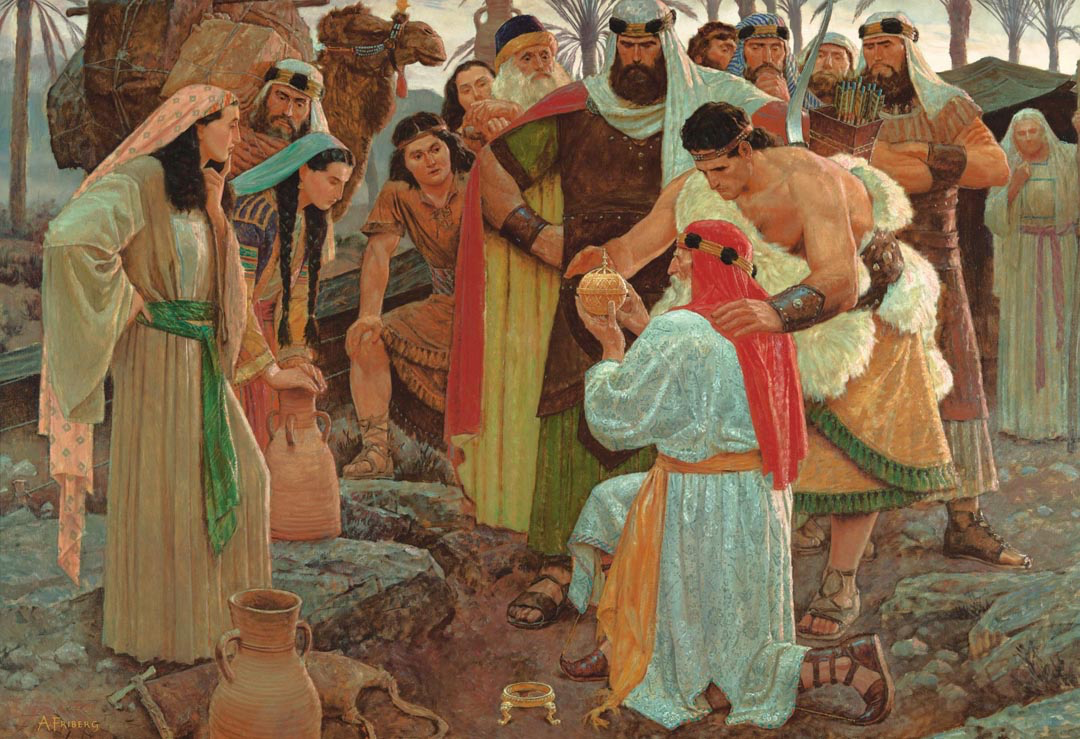 ### Question
From a Latter-day Saint perspective, is there an official theological or artistic explanation for the absence of these items in visual representations of Book of Mormon peoples?
Specifically, I am interested in knowing if:
- There is a belief that these specific "cultural" elements of the Law of Moses were not carried over to the New World.
- The omission is recognized as a matter of "artistic license" rather than historical claim.
- There is scholarly commentary (e.g., from BYU or Maxwell Institute) addressing why Nephite "Law of Moses" observance might have looked visually different from Levantine "Law of Moses" observance.
### Question
From a Latter-day Saint perspective, is there an official theological or artistic explanation for the absence of these items in visual representations of Book of Mormon peoples?
Specifically, I am interested in knowing if:
- There is a belief that these specific "cultural" elements of the Law of Moses were not carried over to the New World.
- The omission is recognized as a matter of "artistic license" rather than historical claim.
- There is scholarly commentary (e.g., from BYU or Maxwell Institute) addressing why Nephite "Law of Moses" observance might have looked visually different from Levantine "Law of Moses" observance.
### Question
From a Latter-day Saint perspective, is there an official theological or artistic explanation for the absence of these items in visual representations of Book of Mormon peoples?
Specifically, I am interested in knowing if:
- There is a belief that these specific "cultural" elements of the Law of Moses were not carried over to the New World.
- The omission is recognized as a matter of "artistic license" rather than historical claim.
- There is scholarly commentary (e.g., from BYU or Maxwell Institute) addressing why Nephite "Law of Moses" observance might have looked visually different from Levantine "Law of Moses" observance.
Asked by Avi Avraham
(1839 rep)
Mar 30, 2026, 02:17 PM
Last activity: Mar 30, 2026, 03:39 PM
Last activity: Mar 30, 2026, 03:39 PM