Was Mahayana a covert 'rebellion' aginst the original teachings of the Buddha?
0
votes
1
answer
6
views
I read the following excerpt from a Hindi Book -


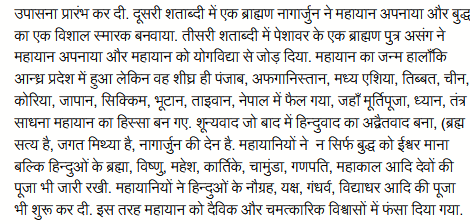 Translation -
> **Due to a lack of the concept of God and the soul (ātman) within the doctrine, certain
> individuals rejected the original Dhamma.** Subhadra was among them, who
> reportedly expressed satisfaction at the Buddha’s passing.
>
> Over time, these dissenters grew organized. Rejecting the original
> Dhamma, they formed the Mahāsāṃghika sect, which was later transformed
> into the Mahāyāna. This shift took place at Vaishali during the Second
> Buddhist Council, roughly a century after the Buddha’s
> Mahāparinirvāṇa. **Mahāyāna thus emerged from those opposed to the
> original teaching, and its adherents systematically sidelined the
> Buddha’s original mission.** By translating the Pali Canon into
> Sanskrit, they rendered it inaccessible to the common people. In the
> process, they undermined Pali literature, weakened the language
> itself, and distorted the original Dhamma.
>
> **The Buddha explicitly taught that he was a human being and should not
> be regarded as God, prophet, or divine messenger. Mahāyānists
> overturned this entirely by deifying him and recasting an originally
> non-theistic teacher into a theistic figure.** While the Buddha never
> endorsed ritualism and worship, they institutionalized precisely those
> practices in his name.
>
> In the 2nd century, a Brahmin named Nagarjuna embraced Mahāyāna and
> monumentalized it. In the 3rd century, another Brahmin from Peshawar,
> Asanga, adopted it and fused it with yogic doctrine. Though Mahāyāna
> originated in Andhra Pradesh, it rapidly spread across Punjab,
> Afghanistan, Central Asia, Tibet, China, Korea, Japan, Sikkim, Bhutan,
> Taiwan, and Nepal , absorbing along the way idol worship, yogic
> practices, and tantra. Śūnyavāda, which would later reappear in
> Hinduism in form of Advaita Vedānta was Nagarjuna’s teaching.
>
> **Mahāyānists did not stop at deifying the Buddha; they freely
> incorporated and continued the worship of Hindu deities such as
> Brahma, Vishnu, Mahesh (Shiva), Kartikeya, Chamunda, Ganesha,
> Mahakala, and others.** They further incorportated the worship Hindu figures like the
> Navagrahas, yakshas, gandharvas, and vidyādharas into their religious
> framework. **In doing so, Mahāyāna became thoroughly entangled and enmeshed in a
> dense web of theistic doctrines and miracle-centered beliefs.**
----------
Is this true ? Is there any support in Buddhist scholarship or early sources for the idea that Mahāyāna arose as a form of covert “rebellion” against the Buddha’s original teachings? Further, Are claims about intentional distortion of the Dhamma through systematic incorporation of external (e.g., Brahmanical) elements supported by evidence?
Translation -
> **Due to a lack of the concept of God and the soul (ātman) within the doctrine, certain
> individuals rejected the original Dhamma.** Subhadra was among them, who
> reportedly expressed satisfaction at the Buddha’s passing.
>
> Over time, these dissenters grew organized. Rejecting the original
> Dhamma, they formed the Mahāsāṃghika sect, which was later transformed
> into the Mahāyāna. This shift took place at Vaishali during the Second
> Buddhist Council, roughly a century after the Buddha’s
> Mahāparinirvāṇa. **Mahāyāna thus emerged from those opposed to the
> original teaching, and its adherents systematically sidelined the
> Buddha’s original mission.** By translating the Pali Canon into
> Sanskrit, they rendered it inaccessible to the common people. In the
> process, they undermined Pali literature, weakened the language
> itself, and distorted the original Dhamma.
>
> **The Buddha explicitly taught that he was a human being and should not
> be regarded as God, prophet, or divine messenger. Mahāyānists
> overturned this entirely by deifying him and recasting an originally
> non-theistic teacher into a theistic figure.** While the Buddha never
> endorsed ritualism and worship, they institutionalized precisely those
> practices in his name.
>
> In the 2nd century, a Brahmin named Nagarjuna embraced Mahāyāna and
> monumentalized it. In the 3rd century, another Brahmin from Peshawar,
> Asanga, adopted it and fused it with yogic doctrine. Though Mahāyāna
> originated in Andhra Pradesh, it rapidly spread across Punjab,
> Afghanistan, Central Asia, Tibet, China, Korea, Japan, Sikkim, Bhutan,
> Taiwan, and Nepal , absorbing along the way idol worship, yogic
> practices, and tantra. Śūnyavāda, which would later reappear in
> Hinduism in form of Advaita Vedānta was Nagarjuna’s teaching.
>
> **Mahāyānists did not stop at deifying the Buddha; they freely
> incorporated and continued the worship of Hindu deities such as
> Brahma, Vishnu, Mahesh (Shiva), Kartikeya, Chamunda, Ganesha,
> Mahakala, and others.** They further incorportated the worship Hindu figures like the
> Navagrahas, yakshas, gandharvas, and vidyādharas into their religious
> framework. **In doing so, Mahāyāna became thoroughly entangled and enmeshed in a
> dense web of theistic doctrines and miracle-centered beliefs.**
----------
Is this true ? Is there any support in Buddhist scholarship or early sources for the idea that Mahāyāna arose as a form of covert “rebellion” against the Buddha’s original teachings? Further, Are claims about intentional distortion of the Dhamma through systematic incorporation of external (e.g., Brahmanical) elements supported by evidence?
Translation -
> **Due to a lack of the concept of God and the soul (ātman) within the doctrine, certain
> individuals rejected the original Dhamma.** Subhadra was among them, who
> reportedly expressed satisfaction at the Buddha’s passing.
>
> Over time, these dissenters grew organized. Rejecting the original
> Dhamma, they formed the Mahāsāṃghika sect, which was later transformed
> into the Mahāyāna. This shift took place at Vaishali during the Second
> Buddhist Council, roughly a century after the Buddha’s
> Mahāparinirvāṇa. **Mahāyāna thus emerged from those opposed to the
> original teaching, and its adherents systematically sidelined the
> Buddha’s original mission.** By translating the Pali Canon into
> Sanskrit, they rendered it inaccessible to the common people. In the
> process, they undermined Pali literature, weakened the language
> itself, and distorted the original Dhamma.
>
> **The Buddha explicitly taught that he was a human being and should not
> be regarded as God, prophet, or divine messenger. Mahāyānists
> overturned this entirely by deifying him and recasting an originally
> non-theistic teacher into a theistic figure.** While the Buddha never
> endorsed ritualism and worship, they institutionalized precisely those
> practices in his name.
>
> In the 2nd century, a Brahmin named Nagarjuna embraced Mahāyāna and
> monumentalized it. In the 3rd century, another Brahmin from Peshawar,
> Asanga, adopted it and fused it with yogic doctrine. Though Mahāyāna
> originated in Andhra Pradesh, it rapidly spread across Punjab,
> Afghanistan, Central Asia, Tibet, China, Korea, Japan, Sikkim, Bhutan,
> Taiwan, and Nepal , absorbing along the way idol worship, yogic
> practices, and tantra. Śūnyavāda, which would later reappear in
> Hinduism in form of Advaita Vedānta was Nagarjuna’s teaching.
>
> **Mahāyānists did not stop at deifying the Buddha; they freely
> incorporated and continued the worship of Hindu deities such as
> Brahma, Vishnu, Mahesh (Shiva), Kartikeya, Chamunda, Ganesha,
> Mahakala, and others.** They further incorportated the worship Hindu figures like the
> Navagrahas, yakshas, gandharvas, and vidyādharas into their religious
> framework. **In doing so, Mahāyāna became thoroughly entangled and enmeshed in a
> dense web of theistic doctrines and miracle-centered beliefs.**
----------
Is this true ? Is there any support in Buddhist scholarship or early sources for the idea that Mahāyāna arose as a form of covert “rebellion” against the Buddha’s original teachings? Further, Are claims about intentional distortion of the Dhamma through systematic incorporation of external (e.g., Brahmanical) elements supported by evidence?
Asked by Void
(1 rep)
Mar 31, 2026, 03:55 PM
Last activity: Mar 31, 2026, 05:41 PM
Last activity: Mar 31, 2026, 05:41 PM